How Traffic Load Affects Road Durability
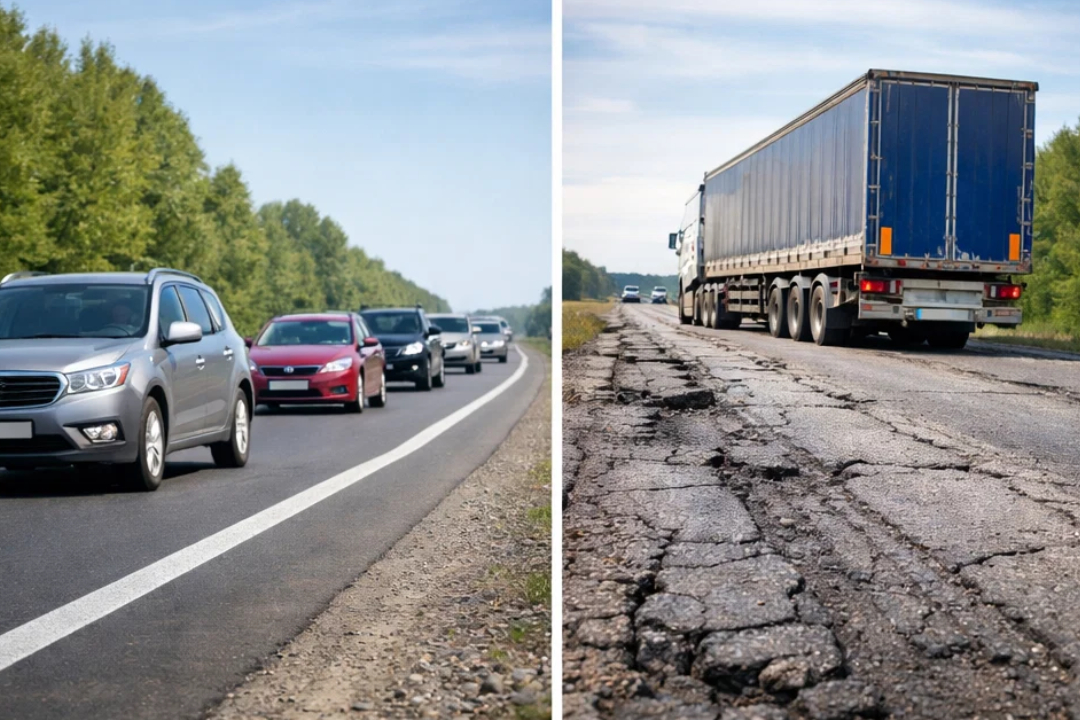
Roads are designed to serve communities for decades, but their lifespan depends heavily on one critical factor: traffic load. While weather, drainage, and material quality all play significant roles, the volume and weight of vehicles using a road daily have the greatest impact on how long that road will last.
Understanding how traffic load affects road durability is essential for proper pavement design, infrastructure planning, and long-term maintenance management.
What Is Traffic Load in Road Engineering?
Traffic load refers to the weight and frequency of vehicles that travel over a road surface. It includes:
-
Passenger cars
-
Buses
-
Delivery vans
-
Heavy-duty trucks
-
Construction equipment
In pavement engineering, the impact of traffic is measured in terms of Equivalent Single Axle Load (ESAL) — a standard method used to convert different vehicle weights into a common comparison value.
One heavy truck can cause as much damage to a road as thousands of small cars. This is why highways carrying heavy trucks deteriorate much faster than residential streets.
1. Repeated Stress and Fatigue Cracking
Every time a vehicle passes over a road, it applies stress to the pavement layers. While roads are designed to withstand repeated loads, continuous heavy traffic leads to fatigue failure over time.
When stress exceeds the pavement’s strength repeatedly:
-
Small cracks begin to form
-
Cracks expand with more traffic
-
Water penetrates the pavement
-
Structural layers weaken
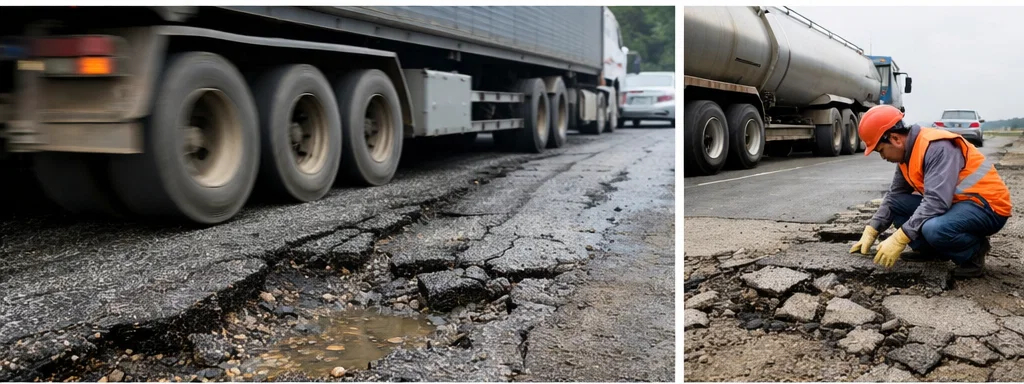
Eventually, this leads to alligator cracking — a common sign of pavement structural failure.
2. Heavy Axle Loads and Structural Damage
The heavier the vehicle, the greater the damage. Heavy trucks exert concentrated pressure on the road surface through their axles.
The damage caused by axle load increases exponentially — not linearly.
For example:
-
Doubling the axle load can increase road damage by up to 16 times.
This explains why:
-
Industrial roads fail quickly if not properly designed.
-
Roads near ports, factories, and construction zones require stronger pavement structures.
To counter this, engineers design thicker pavement layers with stronger base materials where heavy traffic is expected.
3. Rutting and Surface Deformation
Rutting appears as depressions or grooves in the wheel paths of a road. It occurs when traffic load causes permanent deformation in:
-
Asphalt surface layers
-
Base layers
-
Subgrade soil
Heavy vehicles repeatedly traveling along the same lane increase rut depth over time.
Consequences of rutting include:
-
Water accumulation
-
Reduced vehicle control
-
Increased accident risk
-
Faster pavement deterioration
Proper compaction, high-quality materials, and accurate traffic forecasting help reduce rut formation.
4. Increased Shear Stress on Pavement Layers
Traffic load doesn’t only press downward — it also creates horizontal shear forces, especially when vehicles:
-
Brake suddenly
-
Accelerate rapidly
-
Make sharp turns
These forces weaken the bonding between pavement layers, leading to:
-
Surface peeling
-
Pothole formation
-
Delamination
Intersections, roundabouts, and bus stops often experience this type of damage due to constant braking and acceleration.
5. Impact of Traffic Volume on Road Lifespan
Traffic load consists of two key components:
-
Vehicle weight
-
Traffic volume (number of vehicles per day)
Even light vehicles, when present in very high numbers, can shorten pavement life through cumulative stress.
Roads designed for 5,000 vehicles per day may fail prematurely if traffic increases to 20,000 vehicles per day without structural upgrades.
This is why accurate traffic forecasting is critical in road design.
6. Overloading and Its Consequences
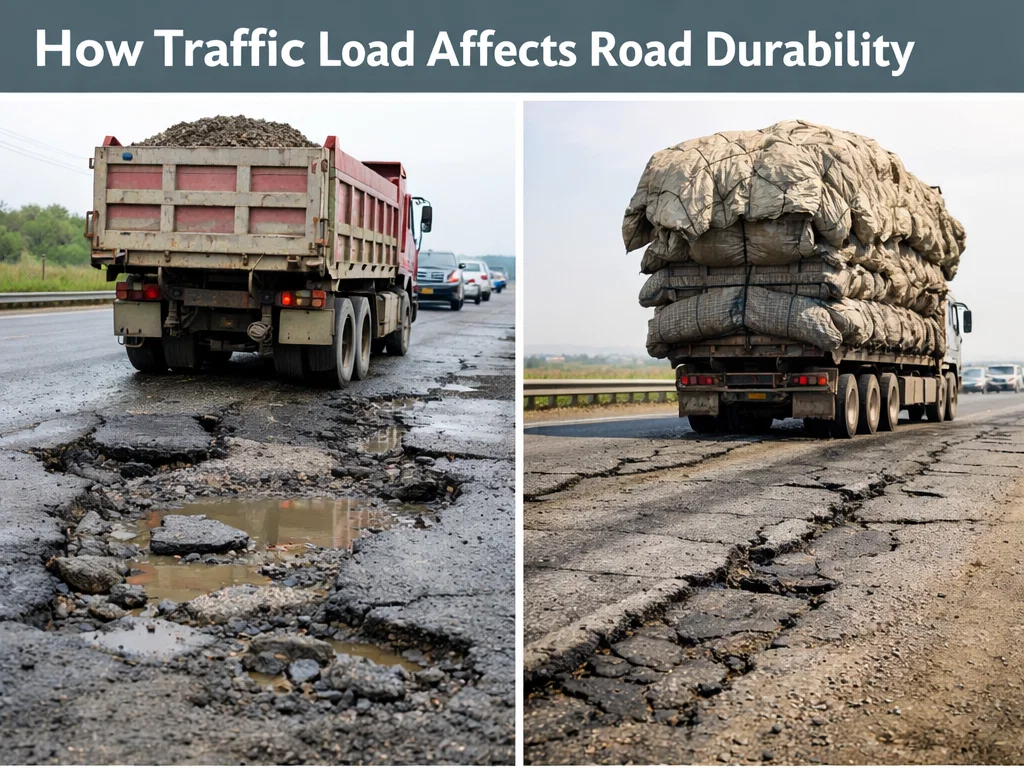
In many regions, overloaded trucks significantly accelerate pavement failure.
Effects of overloading include:
-
Early cracking
-
Base layer failure
-
Excessive settlement
-
Bridge structural stress
-
Shortened pavement lifespan
Without strict axle load control policies, road infrastructure can fail years before its intended design life.
7. Climate Interaction with Traffic Load
Traffic damage worsens under certain environmental conditions:
-
During heavy rainfall, weakened subgrade soils cannot support high loads.
-
In hot climates, asphalt softens, making it more susceptible to rutting.
-
In cold climates, freeze-thaw cycles combined with traffic create rapid cracking.
Traffic load and climate work together to influence overall road durability.
8. Engineering Solutions to Manage Traffic Impact
Civil engineers use several strategies to ensure roads withstand traffic loads:
• Proper Pavement Thickness Design
Stronger sub-base, base, and asphalt layers for heavy-traffic roads.
• Use of High-Performance Materials
Modified asphalt binders and reinforced concrete pavements improve durability.
• Load Distribution Design
Wider lanes and multiple lanes reduce stress concentration.
• Routine Maintenance
Early crack sealing and patching prevent water intrusion and structural failure.
• Weighbridge Enforcement
Controlling overloaded vehicles protects road infrastructure.
9. Economic Impact of Traffic-Induced Damage
Poorly designed roads that fail under traffic load lead to:
-
Frequent repairs
-
High maintenance costs
-
Traffic congestion
-
Increased fuel consumption
-
Economic losses
Investing in proper traffic load analysis during the design phase saves significant long-term costs.
Conclusion
Traffic load is one of the most critical factors affecting road durability. The weight, frequency, and movement patterns of vehicles directly influence pavement performance, structural integrity, and maintenance requirements.
Without accurate traffic load analysis and proper engineering design:
-
Roads crack prematurely
-
Rutting becomes severe
-
Potholes develop
-
Structural failure occurs
However, with professional traffic forecasting, quality materials, and proper pavement design, roads can safely withstand heavy use and serve communities for decades.