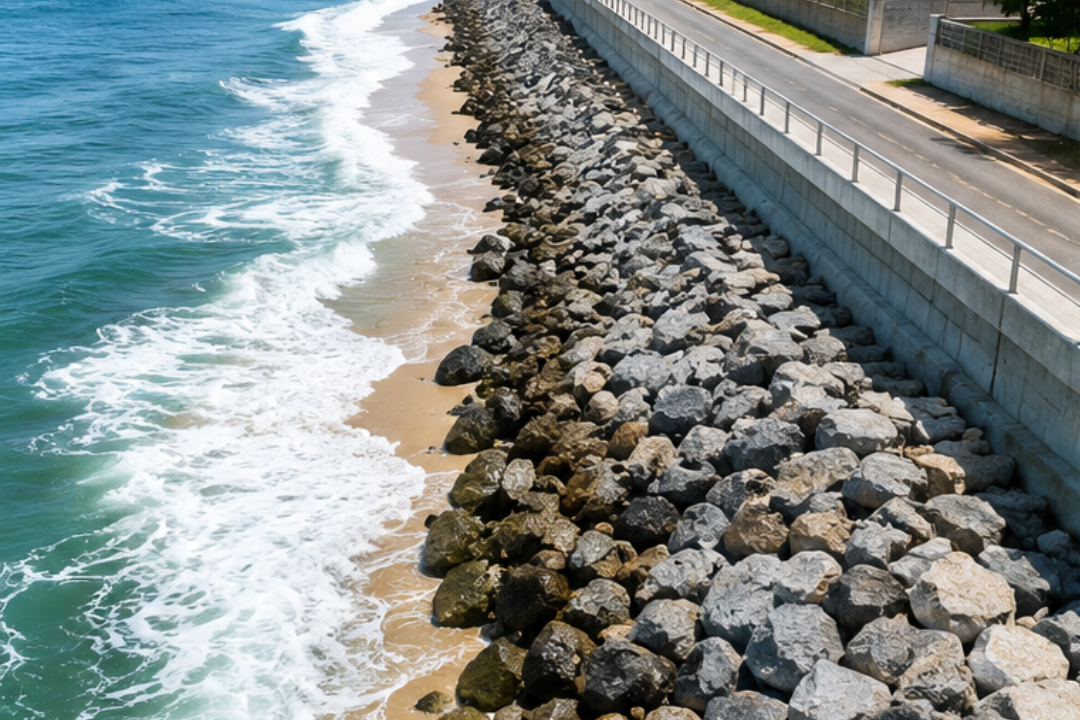
Coastal Erosion Control Techniques
Introduction
Coastal areas are among the most valuable and environmentally sensitive regions in the world. They support communities, businesses, transportation networks, tourism, fisheries, and important ecosystems. However, coastal environments are constantly exposed to waves, tides, currents, storms, rising sea levels, and changing weather patterns.
One of the major challenges facing coastal communities is coastal erosion.
Coastal erosion occurs when waves, currents, wind, and other natural processes remove sediment from beaches, cliffs, shorelines, and coastal land faster than it can naturally be replaced. Human activities can also accelerate the process by altering natural drainage, removing vegetation, constructing infrastructure, or interfering with sediment movement.
If left uncontrolled, coastal erosion can threaten roads, buildings, bridges, drainage systems, utilities, and other infrastructure. It can also result in the loss of valuable land and damage important coastal ecosystems.
Effective coastal erosion control therefore requires careful investigation, engineering design, environmental assessment, and long-term monitoring.
At Heaven’s Gate Engineering and Construction, understanding site conditions and applying appropriate engineering solutions are essential to developing infrastructure that can withstand challenging environmental conditions.
What Causes Coastal Erosion?
Before selecting an erosion control technique, engineers must understand what is causing the shoreline to retreat.
Common causes include:
1. Wave Action
Continuous wave activity can remove sand and other sediments from beaches and coastal slopes. During storms, powerful waves can cause significant erosion within a short period.
2. Tidal Currents
Rising and falling tides transport sediment along the coastline. Changes in tidal patterns can affect the stability of coastal areas.
3. Strong Storms
Storms, hurricanes, and intense rainfall can generate powerful waves and storm surges that rapidly erode beaches and coastal land.
4. Sea-Level Rise
Increasing sea levels can expose coastal areas to deeper water and stronger wave action, increasing long-term erosion risks.
5. Removal of Coastal Vegetation
Mangroves, grasses, shrubs, and other vegetation help stabilize coastal soils. Removing this vegetation can make shorelines more vulnerable to erosion.
6. Human Development
Ports, roads, seawalls, buildings, dredging activities, and other developments can change natural sediment movement and sometimes accelerate erosion in nearby areas.
Why Coastal Erosion Control Is Important
Effective erosion management provides several benefits.
It can help to:
- Protect coastal communities
- Preserve valuable land
- Protect roads and bridges
- Reduce damage to buildings
- Protect drainage infrastructure
- Stabilize beaches and shorelines
- Reduce flood vulnerability
- Protect coastal ecosystems
- Improve long-term infrastructure resilience
The most appropriate solution depends on the site’s environmental, geological, hydraulic, and structural conditions.
1. Seawalls
Seawalls are vertical or near-vertical structures constructed along shorelines to protect land and infrastructure from wave action.
They are commonly constructed using:
- Reinforced concrete
- Masonry
- Steel
- Stone
- Other engineered materials
Seawalls can provide strong protection for developed coastal areas where valuable infrastructure is located close to the shoreline.
However, their design must be carefully considered because reflected wave energy can sometimes contribute to scour or beach erosion in front of the wall.
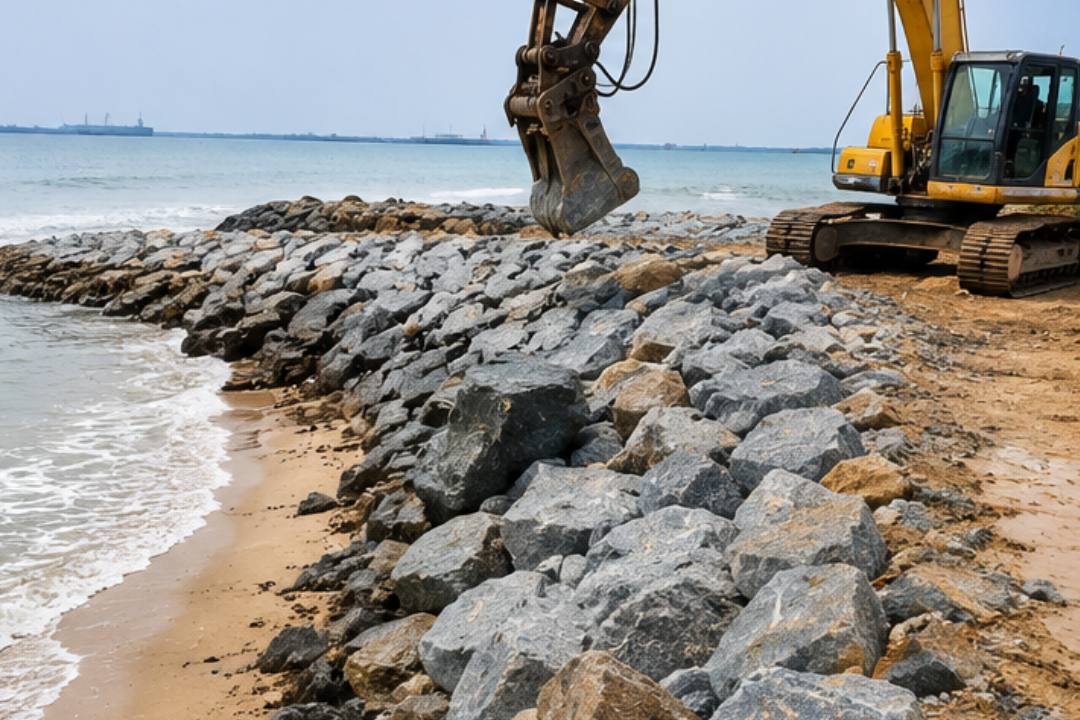
2. Rock Revetments
Rock revetments are sloping protective structures made from large rocks or other durable materials.
The rocks absorb and dissipate wave energy before it reaches the underlying soil.
A properly designed revetment typically includes:
- Armour rock
- Filter layers
- Geotextiles
- Proper slope geometry
- Drainage provisions
Revetments can be particularly useful where a more natural sloping shoreline protection system is preferred.
3. Gabion Structures
Gabions consist of wire mesh baskets filled with stones or other suitable rock materials.
They can be used to stabilize coastal slopes, drainage outlets, embankments, and other areas exposed to water movement.
Advantages can include:
- Flexibility
- Relatively simple installation
- Good drainage
- Resistance to localized erosion
- Adaptability to uneven ground
Proper design and corrosion-resistant materials are important, particularly in saline coastal environments.
4. Groynes
Groynes are structures built perpendicular to the shoreline to interrupt longshore sediment transport.
They are designed to trap or retain sediment on the beach, helping to maintain beach width in areas experiencing erosion.
Groynes can be constructed using materials such as:
- Concrete
- Rock
- Timber
- Steel
However, because groynes alter natural sediment movement, engineers must assess their potential effects on neighboring sections of coastline before construction.
5. Breakwaters
Breakwaters are structures constructed offshore to reduce wave energy reaching the shoreline.
By reducing wave intensity, breakwaters can help create calmer water conditions and reduce shoreline erosion.
They may be:
- Detached from the shore
- Connected to the shore
- Constructed from rock
- Built using concrete or other engineered materials
Breakwaters are often considered where wave exposure is particularly high.
6. Beach Nourishment
Beach nourishment involves adding sand or suitable sediment to an eroding beach to restore its width and elevation.
It can provide several benefits:
- Restores recreational beaches
- Provides a buffer against waves
- Protects coastal infrastructure
- Maintains natural beach characteristics
However, beach nourishment is generally not a permanent solution because waves and currents can gradually transport the added material away.
Regular monitoring and periodic replenishment may therefore be necessary.
7. Coastal Vegetation
Vegetation is one of the most environmentally friendly approaches to coastal erosion management.
Plants can help stabilize soil through their root systems while reducing the impact of wind and surface water.
Suitable coastal vegetation may include:
- Mangroves
- Salt-tolerant grasses
- Native shrubs
- Coastal trees
- Other locally appropriate plants
Vegetation-based solutions are particularly valuable because they can provide habitat for wildlife while contributing to shoreline stability.
8. Mangrove Restoration
Mangroves are highly valuable natural coastal protection systems in suitable tropical and subtropical environments.
Their extensive root systems can help:
- Stabilize sediments
- Reduce wave energy
- Trap sediment
- Provide wildlife habitat
- Support coastal ecosystems
- Improve shoreline resilience
Mangrove restoration can therefore complement conventional engineering structures in appropriate locations.
9. Geotextiles and Erosion Control Fabrics
Geotextiles can be used beneath or around coastal protection systems to stabilize soil and prevent the migration of fine particles.
Depending on their application, geotextiles can:
- Separate soil layers
- Improve filtration
- Reduce soil loss
- Support rock protection
- Improve drainage
- Reinforce weak ground
They are commonly incorporated into engineered erosion control systems.
10. Drainage Management
Poor drainage can significantly increase coastal erosion.
Rainwater flowing over exposed slopes can remove soil and create channels that weaken coastal embankments.
Engineers can reduce this risk through:
- Surface drains
- Culverts
- Channels
- Proper grading
- Energy dissipation structures
- Subsurface drainage
Effective drainage should form part of an integrated coastal erosion management strategy.
11. Slope Stabilization
Coastal cliffs and embankments can become unstable when wave action removes material from their base.
Engineering solutions may include:
- Retaining structures
- Rock revetments
- Soil reinforcement
- Geotextiles
- Terracing
- Vegetative stabilization
The appropriate solution depends on soil conditions, slope geometry, groundwater, wave exposure, and the intended use of the site.
12. Scour Protection
Scour occurs when flowing water removes soil or sediment around foundations, structures, and drainage outlets.
It can be particularly dangerous around:
- Bridges
- Piers
- Culverts
- Seawalls
- Coastal structures
- Drainage outlets
Scour protection may involve rock armour, concrete protection, gabions, geotextiles, or other engineered systems.
Proper hydraulic analysis is essential before selecting a scour protection method.
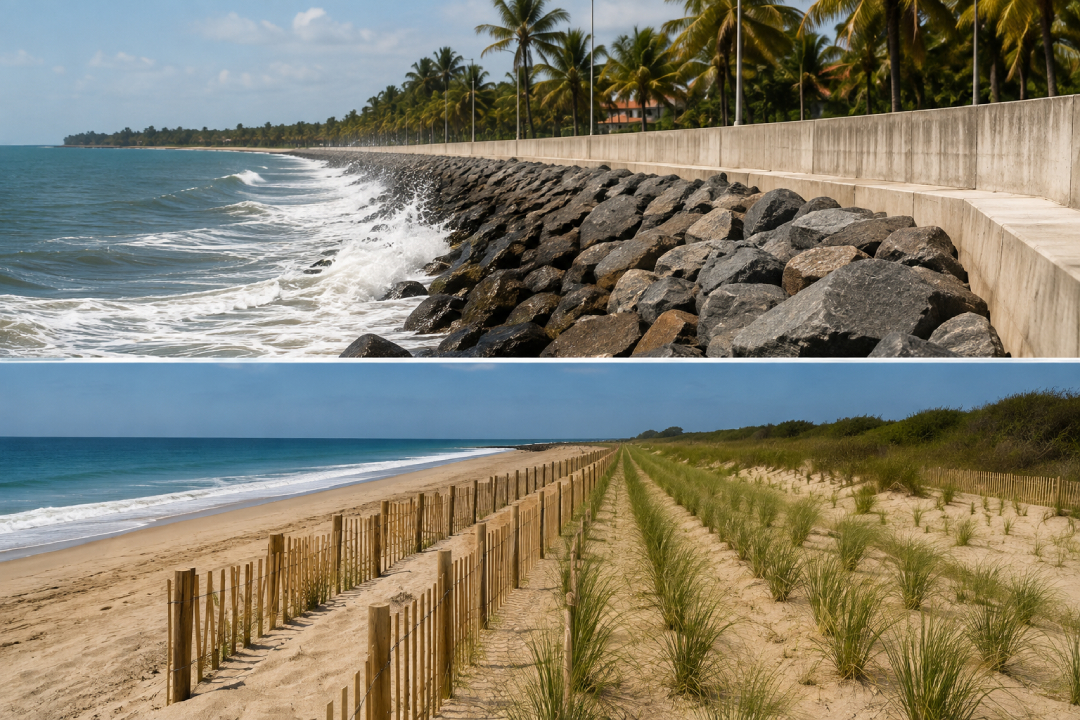
Hard Engineering vs. Nature-Based Solutions
Coastal erosion management generally involves two broad approaches.
Hard Engineering
Hard engineering involves constructed structures designed to resist or redirect coastal forces.
Examples include:
- Seawalls
- Groynes
- Breakwaters
- Revetments
- Gabions
These solutions can provide strong protection for infrastructure but may alter natural coastal processes if poorly designed.
Nature-Based Solutions
Nature-based approaches work with natural coastal processes.
Examples include:
- Mangrove restoration
- Beach nourishment
- Dune restoration
- Coastal vegetation
- Wetland restoration
These approaches can provide environmental benefits while improving coastal resilience.
In many situations, combining engineered structures with nature-based solutions can provide a more sustainable approach.
How Engineers Select the Right Coastal Protection Method
There is no single erosion control solution that works for every coastline.
Before recommending a system, engineers may assess:
- Soil characteristics
- Coastal geology
- Wave conditions
- Tidal range
- Current velocities
- Sediment movement
- Storm surge
- Drainage patterns
- Groundwater conditions
- Existing infrastructure
- Environmental impacts
- Future development
- Long-term maintenance requirements
Hydrological, hydraulic, geotechnical, and environmental investigations provide the information required to develop an appropriate design.
The Importance of Coastal Site Investigation
A detailed site investigation is critical before construction begins.
Engineers may conduct:
- Topographic surveys
- Bathymetric surveys
- Geotechnical investigations
- Soil testing
- Wave analysis
- Tidal studies
- Sediment assessments
- Environmental assessments
These investigations help engineers understand how water and sediment interact with the shoreline.
Without sufficient investigation, a coastal protection structure may solve erosion in one location while unintentionally increasing erosion elsewhere.
Construction Quality Matters
Even a well-designed erosion control system can fail if construction quality is poor.
During construction, engineers should monitor:
- Material quality
- Foundation preparation
- Structural dimensions
- Rock size and placement
- Reinforcement
- Geotextile installation
- Drainage
- Alignment
- Compaction
- Connection details
Professional site supervision ensures that the constructed system reflects the approved engineering design.
Monitoring and Maintenance
Coastal protection should not be treated as a one-time construction activity.
Waves, tides, storms, sediment movement, and environmental conditions continuously change.
Regular inspections should identify:
- Cracks
- Settlement
- Scour
- Displaced rocks
- Damaged structures
- Blocked drainage
- Vegetation loss
- Foundation exposure
Early intervention can prevent small defects from developing into major failures.
Using Technology for Coastal Erosion Management
Modern technology is improving the way engineers study and manage coastal erosion.
Useful technologies include:
Drones
Drones can capture high-resolution aerial imagery for monitoring shoreline changes.
GIS
Geographic Information Systems can help engineers analyze coastal terrain, land use, flood risks, and shoreline movement.
Remote Sensing
Satellite imagery can help track long-term changes in coastline position.
Hydraulic and Coastal Modeling
Computer models can simulate wave conditions, currents, sediment movement, and potential erosion scenarios.
These tools allow engineers to make better-informed decisions before construction begins.
Sustainable Coastal Erosion Management
Long-term coastal protection should balance engineering performance with environmental responsibility.
Sustainable approaches may include:
- Protecting existing vegetation
- Restoring mangroves
- Using locally appropriate materials
- Minimizing unnecessary shoreline modification
- Combining hard and soft protection methods
- Monitoring sediment movement
- Designing for future climate conditions
- Maintaining drainage systems
The goal should not simply be to stop erosion at one point, but to develop a resilient coastal system that remains functional over time.
Conclusion
Coastal erosion is a complex engineering and environmental challenge. Waves, currents, storms, sea-level changes, vegetation loss, and human development can all contribute to shoreline instability.
Effective control techniques include seawalls, revetments, gabions, groynes, breakwaters, beach nourishment, vegetation restoration, mangrove rehabilitation, geotextiles, drainage improvements, and scour protection.
However, the best solution depends on the unique characteristics of each coastal site. Detailed investigations, appropriate engineering design, quality construction, professional supervision, and continuous maintenance are essential for achieving long-term results.
At Heaven’s Gate Engineering and Construction, we believe durable infrastructure begins with understanding the environment in which it is built. Through professional engineering, careful planning, quality construction, and responsible project management, we support infrastructure solutions designed for safety, resilience, and long-term performance.